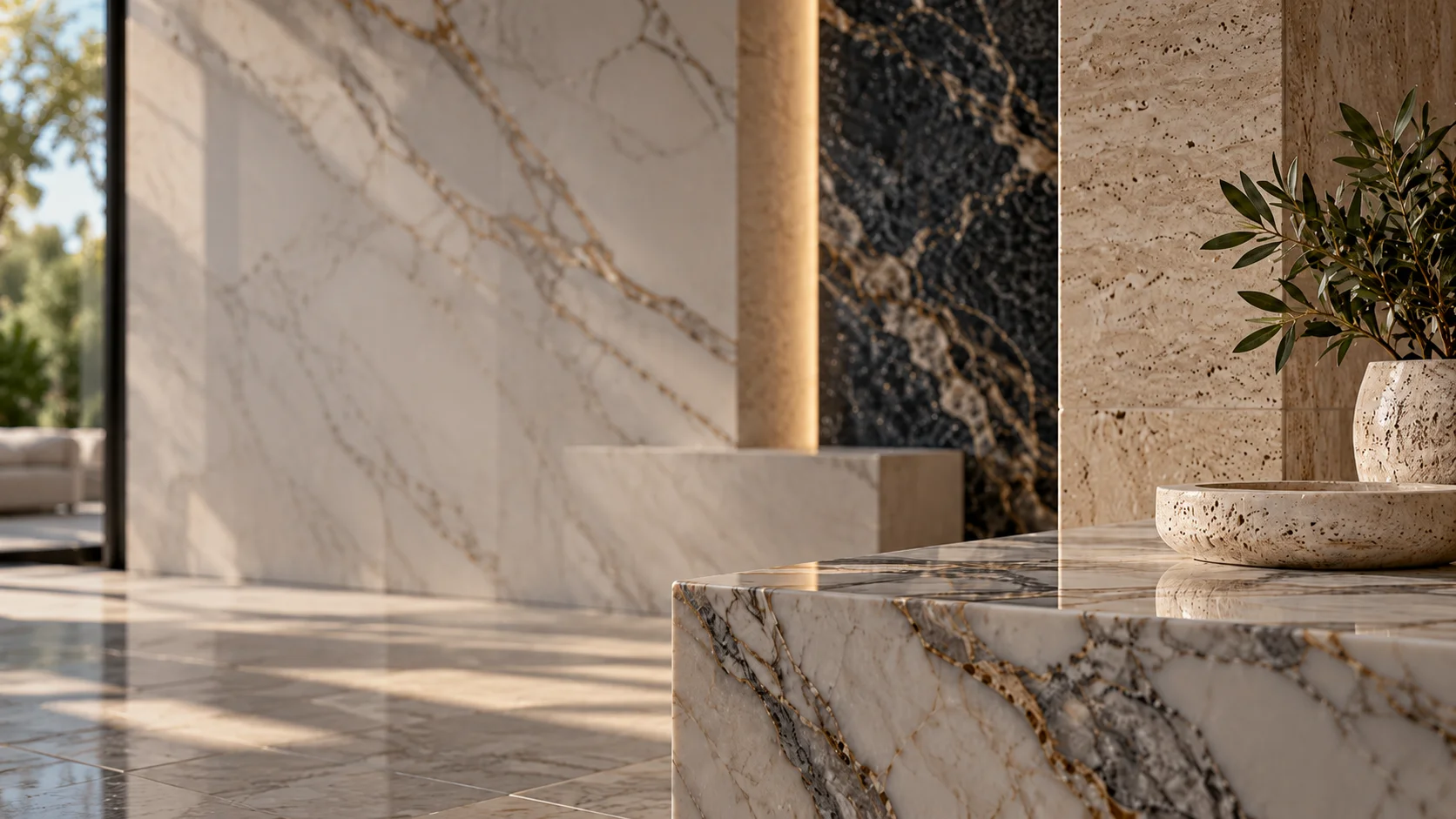
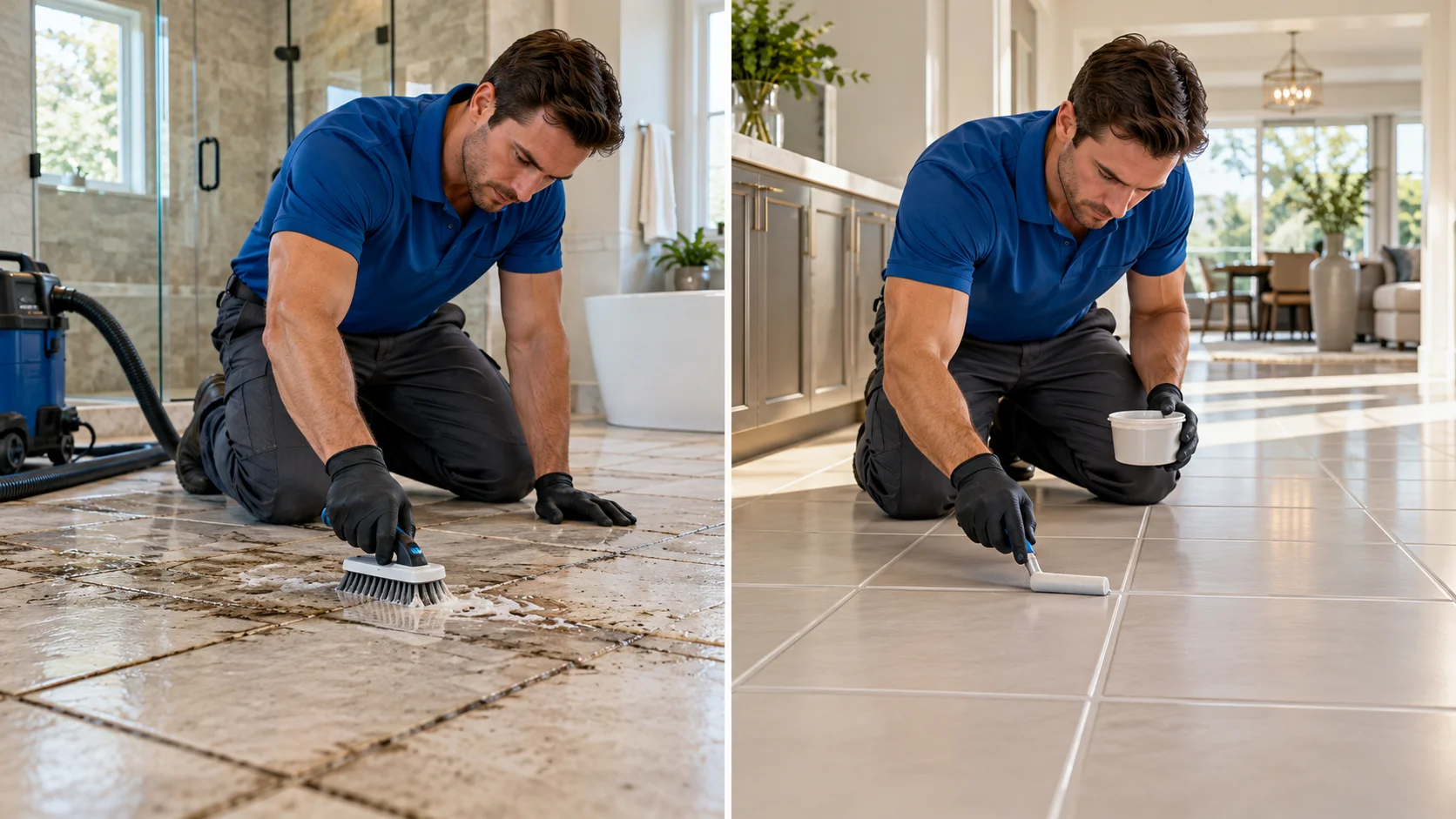
Natural stone adds character, durability and elegance to kitchens, bathrooms, floors and other surfaces. However, proper natural stone cleaning is essential to preserve its appearance and avoid damage caused by unsuitable household products.
Whether you have polished marble countertops, granite kitchen surfaces or travertine floors, using the wrong cleaner can cause dullness, staining, scratches or even permanent changes to the stone’s finish.
The safest general approach is to use a pH-neutral, stone-compatible cleaner, soft cleaning tools and appropriate maintenance methods. Acidic cleaners, abrasive products and harsh chemical treatments should be avoided unless a qualified professional determines that a particular product is suitable.
In this Natural Stone Cleaning Guide 2027, we’ll explain how to clean marble, granite and travertine, which products to avoid, how to recognize common surface problems and when professional restoration may be necessary.
For homeowners throughout Houston, TX and the Greater Houston area, Delta Grout Cleaning LLC provides specialized natural stone cleaning, honing and polishing services tailored to the condition and characteristics of each material.
Why Natural Stone Requires Special Cleaning Products
Not all natural stone surfaces react to cleaning products in the same way.
Marble, granite and travertine differ in mineral composition, porosity, finish and susceptibility to chemical damage. A product that appears suitable for one material may create problems when used on another.
According to the Natural Stone Institute’s Care & Cleaning Guidelines, identifying the stone’s composition is one of the first steps in selecting an appropriate cleaning method.
For example:
- Marble is generally calcium carbonate-based and can be etched by acidic substances.
- Travertine is also calcium carbonate-based and requires particular care with acidic products.
- Granite is generally a silicate-based stone and is often more resistant to common household acids, although its exact mineral composition, finish and any applied treatment must still be considered.
This is why a universal cleaning product is not always the best choice for every natural stone surface.
Marble vs. Granite vs. Travertine: Cleaning and Maintenance Comparison
Understanding the differences between these materials is essential before choosing cleaning products or restoration treatments.
| Feature | Marble | Granite | Travertine |
|---|---|---|---|
| Stone characteristics | Usually calcium carbonate-based | Generally silicate-based | Calcium carbonate-based |
| Sensitivity to acids | High | Varies; acid-based cleaners are still discouraged | High |
| Routine cleaning | pH-neutral stone cleaner | Stone-compatible neutral cleaner | pH-neutral stone cleaner |
| Cleaning tools | Soft cloth or microfiber mop | Soft cloth or microfiber mop | Soft cloth or microfiber mop |
| Common concerns | Etching, dullness, scratches, stains | Stains, residue, finish deterioration | Dirt in pores, etching, stains, wear |
| Possible restoration | Honing and polishing | Cleaning and polishing, as appropriate | Cleaning, honing and polishing |
| Sealing considerations | Depends on stone and application | Depends on stone and application | Depends on stone and application |
Important: These are general care guidelines. The correct treatment depends on the stone’s exact characteristics, existing finish, installation and manufacturer recommendations.
What Are the Best Products for Natural Stone Cleaning?
For routine maintenance, the most useful products are generally those that clean without unnecessarily attacking or abrading the stone.
1. pH-Neutral Natural Stone Cleaners
A pH-neutral cleaner formulated for natural stone is a strong general choice for routine cleaning of suitable marble, granite and travertine surfaces.
Benefits include:
- Suitable formulations for regular maintenance.
- Lower risk of acid-related damage compared with acidic household cleaners.
- Compatibility with many natural stone finishes when used according to instructions.
- Availability of products specifically designed for stone countertops and floors.
Pros: Convenient for routine cleaning, available in formulations for different applications and generally gentle when properly selected.
Cons: May not remove deeply embedded stains, etching, scratches or accumulated deposits requiring specialized restoration.
Always confirm the product label identifies the intended stone type and surface.
2. Microfiber Cloths and Soft Mops
Soft microfiber cloths and clean, nonabrasive mops are useful for maintaining natural stone.
They help remove loose dirt and surface residue without introducing the mechanical abrasion associated with aggressive scrubbers.
Pros: Reusable, simple to maintain and suitable for many regular cleaning tasks.
Cons: Cannot correct permanent surface damage or deeply embedded discoloration.
For polished countertops, use a clean microfiber cloth and dry the surface after cleaning to minimize streaks and water spots.
3. Mild Soap and Water
The Natural Stone Institute also describes mild liquid dishwashing detergent and warm water as an option for routine stone cleaning.
However, using too much soap can leave a film or streaks.
Pros: Accessible and useful for light cleaning when appropriately diluted.
Cons: Excessive soap can leave residue; products containing unsuitable additives may not be appropriate for the stone.
For routine maintenance, a dedicated stone cleaner is often easier to select because its intended use and compatibility are more clearly defined.
4. Specialized Stone Care Products
Certain stains, mineral deposits or surface conditions may require products formulated for a particular stone and problem.
However, specialized products are not automatically safer simply because they are marketed for stone.
Before using any treatment, check:
- Whether it is approved for marble, granite or travertine.
- Whether the stone is polished, honed or otherwise finished.
- Whether a sealer or topical coating is present.
- The manufacturer’s application and safety instructions.
- Whether the product could affect grout, surrounding materials or fixtures.
When compatibility is uncertain, professional evaluation is preferable to experimenting with aggressive chemicals.
Natural Stone Cleaning Products: What to Use and What to Avoid
The following table summarizes common household products and their suitability for routine natural stone maintenance.
| Product or method | Recommendation | Reason |
|---|---|---|
| pH-neutral, stone-compatible cleaner | Recommended | Appropriate for routine care when approved for the surface |
| Clean microfiber cloth | Recommended | Gentle cleaning without aggressive abrasion |
| Soft mop with clean water | Recommended | Useful for routine floor maintenance |
| Mild detergent, properly diluted | Conditional | May be suitable but excess product can leave residue |
| White vinegar | Avoid | Acidic; can etch calcium carbonate-based stones |
| Lemon juice | Avoid | Acidic and potentially damaging to marble and travertine |
| Abrasive scouring powders | Avoid | Can scratch or dull certain stone finishes |
| Steel wool or harsh scrubbers | Avoid | Risk of mechanical scratching |
| Acidic bathroom or toilet cleaners | Avoid | May damage stone and surrounding materials |
| General-purpose cleaners of unknown composition | Use caution | Compatibility cannot be assumed |
| Stone-compatible penetrating sealer | Conditional | Depends on stone, condition and product suitability |
A product’s suitability must be determined by its formulation, the stone and the finish—not just whether it is described as natural, homemade or professional.
Can You Use Vinegar to Clean Marble, Granite or Travertine?
Vinegar is often recommended in household cleaning advice, but it should not be treated as a universal natural stone cleaner.
Vinegar contains acetic acid.
On calcium carbonate-based stones such as marble and travertine, acidic substances can react with the surface and cause etching.
Etching may appear as dull spots, changes in reflectivity or loss of polish.
Vinegar on Marble
Not recommended.
Marble can react to acids, and even brief exposure may affect certain polished surfaces.
Vinegar on Travertine
Not recommended.
Travertine shares the acid sensitivity of other calcium carbonate-based stones.
Vinegar on Granite
Although many granites are more acid-resistant than marble, vinegar is still not recommended as a general granite maintenance product.
Granite’s mineral composition and any applied treatments can vary, so a compatible neutral cleaner is a more reliable choice.
For detailed guidance, consult the Natural Stone Institute.
How to Clean Marble Surfaces Safely
Marble is valued for its natural veining and refined appearance, but it requires care to preserve its finish.
Recommended Marble Cleaning Steps
- Remove loose dust and debris with a soft cloth or appropriate mop.
- Apply a stone-compatible, pH-neutral cleaner according to its instructions.
- Gently wipe the surface without aggressive scrubbing.
- Rinse when required by the product instructions.
- Dry with a clean microfiber cloth.
Common Marble Cleaning Mistakes
Avoid acidic kitchen cleaners, vinegar, lemon juice, abrasive powders and aggressive scrubbing pads.
Be especially careful with polished marble countertops and bathroom surfaces, where changes in the finish may become highly visible.
When Marble Cleaning Isn’t Enough
If your marble has persistent dull patches, etching, scratches or loss of polish, regular cleaning may not correct the problem.
Depending on the condition, professional marble honing and polishing can help restore a more even finish.
Learn about Marble Honing & Polishing in Houston, TX.
How to Clean Granite Countertops and Floors
Granite is widely used in kitchens and other frequently used areas because of its durability.
However, durable does not mean maintenance-free.
Grease, food residue, spills and inappropriate cleaning products can affect the appearance of granite surfaces.
Recommended Granite Cleaning Steps
- Remove loose dirt and crumbs.
- Use a cleaner specifically approved for natural stone and the granite’s finish.
- Wipe with a soft cloth or microfiber mop.
- Remove cleaning residue as instructed.
- Dry the surface to minimize water spots and streaking.
What Should You Avoid on Granite?
Avoid abrasive cleaning methods, harsh scouring products and unidentified acidic chemicals.
Do not assume a stain or dull area requires stronger cleaning. The issue may involve the sealer, finish or another condition requiring assessment.
Can Granite Be Professionally Polished?
Depending on its condition and finish, professional granite cleaning and polishing may help improve the appearance of a worn or dull surface.
Different finishes and stone types require different approaches.
Explore our Granite Cleaning & Polishing Services in Houston.
How to Clean Travertine Floors and Showers
Travertine is a natural stone with distinctive texture and characteristics. Its surface may include pores, filled areas and different finishes.
These characteristics make proper cleaning especially important.
Recommended Travertine Cleaning Steps
- Remove loose dust, sand and debris.
- Use a pH-neutral cleaner suitable for travertine.
- Clean with a soft mop or nonabrasive cloth.
- Avoid excessive product buildup.
- Rinse as directed and dry the surface.
Why Does Travertine Become Dull?
A travertine surface may appear dull because of dirt, surface wear, acid etching or deterioration of its existing finish.
The solution depends on the cause.
Cleaning can remove dirt and residue, but it does not reverse chemical etching or physical damage.
When Should Travertine Be Restored?
Professional care may be appropriate when travertine shows persistent dullness, scratches, embedded dirt or wear that routine cleaning cannot resolve.
Depending on the stone and its finish, the recommended treatment may include cleaning, honing or polishing.
Learn more about Travertine Cleaning & Polishing in Houston, TX.
Natural Stone Stains vs. Etching: How Can You Tell the Difference?
One of the most important aspects of natural stone maintenance is understanding that a stain and an etch mark are not the same problem.
A stain involves material that has penetrated or discolored the stone.
Etching is a chemical alteration to the stone’s surface, often resulting in a dull mark or change in its finish.
Common Signs of a Stain
- A darker or differently colored area.
- Discoloration associated with a spill.
- A mark that remains after ordinary cleaning.
- Possible absorption of oil or other substances.
Common Signs of Etching
- A dull spot on an otherwise polished surface.
- A change in shine or reflectivity.
- A mark associated with contact with an acidic substance.
- A surface that looks cloudy despite being clean.
| Problem | Typical appearance | Possible approach |
|---|---|---|
| Surface dirt | Residue or general dullness | Appropriate cleaning |
| Oil-based stain | Localized darkening | Stone-specific stain treatment |
| Mineral residue | Deposits or spots | Compatible treatment after assessment |
| Etching | Dull or altered finish | Professional honing or polishing where appropriate |
| Scratches | Visible surface abrasion | Mechanical restoration where feasible |
| Deep damage | Cracks, chips or structural defects | Repair assessment; cleaning alone is insufficient |
Because appearance alone cannot always establish the cause, difficult cases should be assessed before applying stain removers or restoration products.
DIY Natural Stone Cleaning vs. Professional Stone Restoration
Homeowners can perform many routine cleaning tasks themselves.
However, there is a difference between maintaining natural stone and restoring a damaged or worn surface.
| Factor | DIY Maintenance | Professional Restoration |
|---|---|---|
| Main purpose | Routine cleanliness | Address specific surface deterioration |
| Equipment | Household tools and compatible cleaners | Specialized equipment and methods |
| Suitable for | Light dirt and routine upkeep | Certain stains, dullness, etching and finish problems |
| Initial cost | Usually lower for simple maintenance | Depends on area and work required |
| Risk | Increases with unsuitable products or methods | Requires a qualified provider and correct treatment |
| Result | Maintains the existing finish | May improve or restore the finish |
| Best choice | Regular maintenance | Problems routine cleaning cannot resolve |
Benefits of DIY Natural Stone Cleaning
- Practical for routine maintenance.
- Helps manage everyday dirt and spills.
- Can reduce unnecessary professional service visits.
- Encourages regular attention to surfaces.
Limitations of DIY Cleaning
- Does not normally correct etching or scratches.
- Stronger chemicals can create additional damage.
- Incorrect abrasive methods may change the finish.
- Deep stains may require specialized evaluation.
Benefits of Professional Restoration
- The surface can be assessed before selecting a treatment.
- Different methods may be used for different stones and finishes.
- Certain dull, scratched or etched areas may be improved.
- Cleaning, honing, polishing and other treatments can be considered together when appropriate.
Limitations of Professional Restoration
- Results depend on the condition and type of stone.
- Not every defect can be removed.
- Some damage may require repair or replacement.
- Ongoing maintenance is still necessary after restoration.
The right choice is not always the most intensive treatment. Regular cleaning is appropriate for many surfaces, while specialized restoration should be considered when the problem extends beyond ordinary dirt.
Does Natural Stone Need to Be Sealed?
Sealing is a common consideration in natural stone care, but not every stone requires the same treatment.
Some stones may benefit from a suitable impregnating sealer, while others may not require sealing under their particular conditions.
Importantly, sealing does not make natural stone completely stain-proof.
As the Natural Stone Institute explains, impregnating sealers generally improve resistance to staining rather than creating an absolute barrier against all liquids and contaminants.
The need for sealing depends on:
- The stone’s characteristics and absorption.
- Its location and exposure to spills.
- The existing finish.
- Whether the surface has been sealed previously.
- Product suitability and manufacturer recommendations.
A professional evaluation can help determine whether sealing is appropriate and which product should be used.
Natural Stone Care for Houston Homes
Homeowners throughout Houston, TX and the Greater Houston area use natural stone in kitchens, bathrooms, showers, entryways and other interior surfaces.
Everyday exposure to food spills, moisture, foot traffic and household cleaning products can affect these materials over time.
Water quality can also influence maintenance needs.
The U.S. Geological Survey explains that hard water contains dissolved calcium and magnesium, which can contribute to soap scum and mineral deposits.
These deposits may become noticeable around showers, sinks and other frequently wet surfaces. However, water hardness can vary by water supplier and property, so the conditions of an individual Houston home should not be assumed without verification.
When buildup develops on marble, granite or travertine, it is especially important to avoid using aggressive acidic removers without first confirming their compatibility with the stone.
Professional assessment may help identify whether the issue involves removable residue, staining or damage to the finish.
Professional Natural Stone Restoration in Greater Houston
Delta Grout Cleaning LLC provides professional tile, grout and natural stone restoration services for residential and commercial properties in Houston and surrounding communities.
Our service coverage includes areas across Harris, Fort Bend, Montgomery and Galveston counties, including communities such as:
Houston, Katy, Cypress, Spring, Tomball, Sugar Land, The Woodlands, Conroe, Richmond, Missouri City, League City and Friendswood, among other locations.
You can explore the complete coverage area on our Areas We Serve page.
Our restoration services include:
- Granite Cleaning & Polishing — for suitable granite countertops and other stone surfaces requiring specialized cleaning or polishing.
- Marble Honing & Polishing — for marble surfaces affected by dullness, wear or certain finish imperfections.
- Travertine Cleaning & Polishing — for travertine floors and other surfaces requiring professional stone care.
- Tile & Grout Cleaning and Sealing — for tiled surfaces and grout joints affected by dirt and buildup.
- Grout Color Sealing — for suitable grout requiring a more consistent color and stain protection.
- Shower Restoration — for showers requiring specialized cleaning, grout work or surface restoration.
The appropriate service depends on the material, condition and desired result.
How to Maintain Natural Stone Between Professional Cleanings
A consistent maintenance routine can help preserve the appearance of natural stone and reduce unnecessary exposure to unsuitable products.
Daily or Regular Maintenance
Remove dust, loose dirt and spills with compatible, nonabrasive cleaning tools.
Use a suitable cleaner only as needed and follow the product’s instructions.
Kitchen Maintenance
Clean spills promptly, use appropriate protection beneath items that could scratch the surface and avoid acidic cleaners on vulnerable natural stones.
Bathroom Maintenance
Remove excess moisture after use where practical and avoid leaving concentrated cleaning chemicals on stone surfaces.
A squeegee can help reduce the accumulation of water and soap residue on suitable shower surfaces.
Floor Maintenance
Remove grit and dust regularly, since tracked-in particles can contribute to abrasion.
Use clean, soft mops and avoid aggressive scrubbing pads.
Periodic Surface Evaluation
If the stone develops persistent stains, uneven shine, etching, scratches or visible deterioration, identify the cause before applying more intensive treatments.
Proper diagnosis can prevent unnecessary work and help protect the existing material.
Frequently Asked Questions About Natural Stone Cleaning
What is the safest way to clean natural stone?
For routine maintenance, use a pH-neutral, stone-compatible cleaner and a soft cloth or mop, following the product manufacturer’s instructions. The exact method depends on the stone type and finish.
Can I use vinegar on natural stone?
Vinegar is not recommended as a general natural stone cleaner. It can etch acid-sensitive stones such as marble and travertine, and a compatible neutral cleaner is generally a safer choice for granite maintenance as well.
Can you use the same cleaner on marble and granite?
Some properly formulated pH-neutral stone cleaners are suitable for both, but product compatibility should always be checked. Marble and granite have different characteristics and may respond differently to chemicals.
Is travertine harder to maintain than granite?
Travertine generally requires particular attention to acid exposure and surface characteristics. However, maintenance requirements also depend on the stone’s finish, installation, use and condition.
Can professional cleaning remove stains from marble?
Some stains may respond to specialized treatment, but not all discoloration can be removed through ordinary cleaning. Etching and scratches are different problems and may require honing or polishing rather than stain removal.
Does professional stone polishing remove scratches?
Certain surface scratches and finish imperfections may be improved through appropriate honing and polishing. Results depend on the depth of the damage, the material and its existing finish.
How often should natural stone be professionally cleaned?
There is no single schedule suitable for every surface. Professional care depends on the level of use, visible condition, stone characteristics and effectiveness of routine maintenance.
Should granite countertops be sealed?
Some granite surfaces may benefit from an appropriate sealer, while others may not require one. The decision should consider the stone’s absorption, condition and manufacturer recommendations.
Can hard water damage natural stone?
Hard water can contribute to mineral deposits and soap residue. Some cleaners used to remove these deposits may also damage acid-sensitive stone, so selecting a compatible cleaning method is important.
Is natural stone restoration better than replacement?
Restoration may be appropriate when the existing stone is structurally suitable and the main concerns involve appearance, finish or certain forms of surface wear. Significant structural damage may require repair or replacement.
Does Delta Grout Cleaning LLC provide natural stone cleaning in Houston?
Yes. Delta Grout Cleaning LLC provides professional granite cleaning and polishing, marble honing and polishing, and travertine cleaning and polishing in Houston and surrounding service areas.
How can I get a natural stone restoration estimate in Houston?
You can contact Delta Grout Cleaning LLC and describe the material, surface condition and problem. Photos may help with an initial evaluation, although some projects require further inspection to determine the appropriate treatment.
Protect Your Natural Stone With the Right Care
Natural stone surfaces can remain attractive and functional with appropriate maintenance, but the wrong cleaning products can create problems that ordinary cleaning cannot reverse.
Whether you are maintaining a granite countertop, caring for marble floors or restoring worn travertine, understanding the material is the first step toward choosing the right treatment.
For routine maintenance, use compatible products and gentle methods. When you notice persistent stains, etching, scratches or significant dullness, professional evaluation can help determine whether cleaning, honing, polishing or another restoration service is suitable.
Delta Grout Cleaning LLC specializes in tile, grout and natural stone restoration throughout Houston, TX and the Greater Houston area.
If your natural stone needs professional attention, we’re here to help you explore the right solution.
You can also browse our Before & After Gallery to see examples of our restoration work.
Sources and Further Reading
Natural Stone Institute — Care & Cleaning of Natural Stone
https://www.naturalstoneinstitute.org/consumers/care/
Technical information about stone characteristics, appropriate cleaners, acid sensitivity, maintenance and sealing.
Natural Stone Institute — A Homeowner’s Guide to Natural Stone Countertops
Information on natural stone countertops, acid etching, cleaning precautions and material characteristics.
U.S. Geological Survey — Hardness of Water
https://www.usgs.gov/water-science-school/science/hardness-water
Scientific background on dissolved minerals, water hardness and soap scum formation.
Published by Delta Grout Cleaning LLC, Houston, Texas.
Prepared: October 2026. Editorial guide for 2027; product recommendations should be reassessed as manufacturer guidance changes.
This article provides general maintenance guidance. The suitability of a cleaning or restoration product depends on the specific stone, finish, installation and product manufacturer’s instructions.